
Ai Refloat
Ai Refloat: Reconstructing a Lost Ship When No Plans Survive
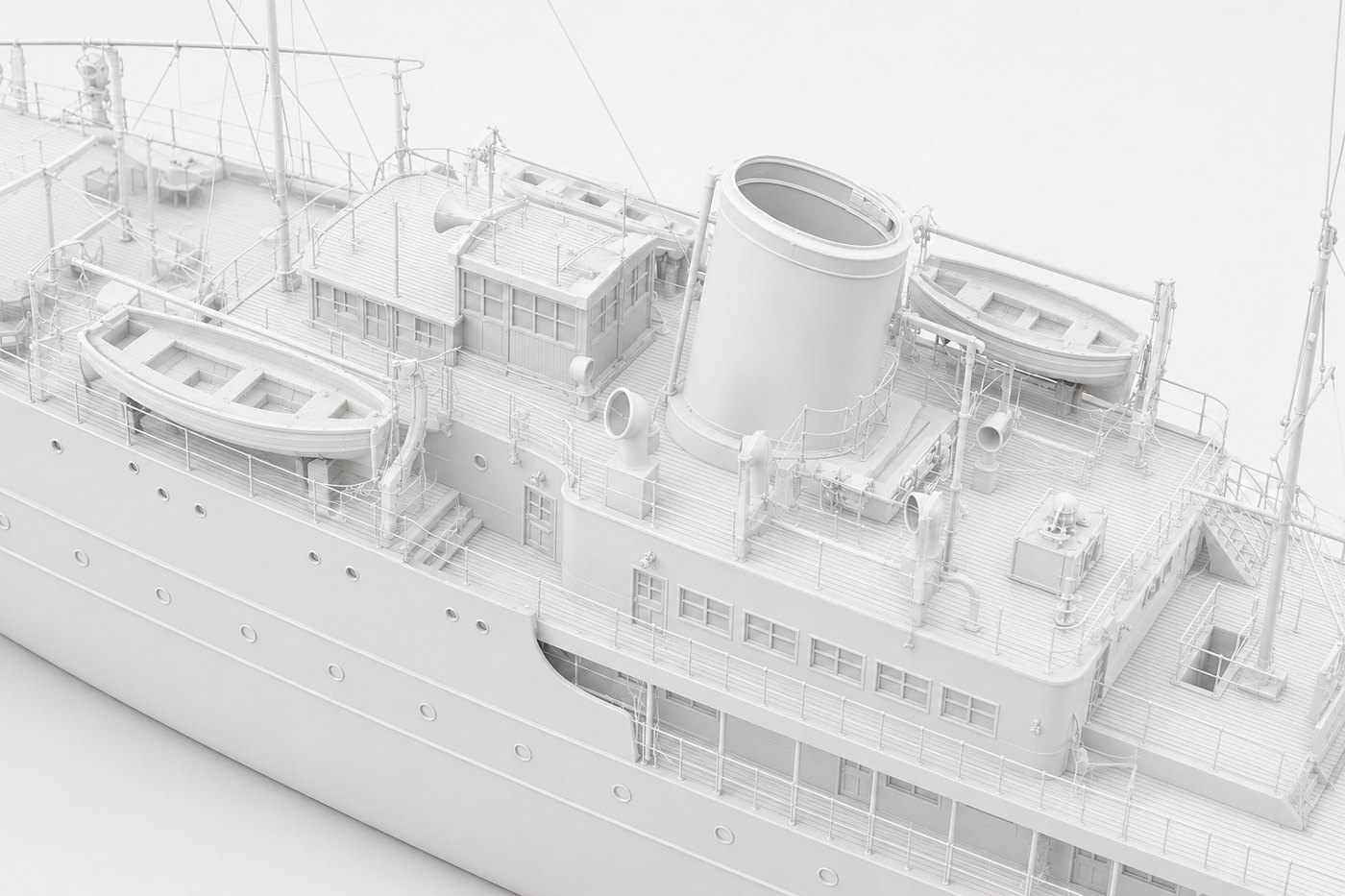
Many of the vessels most worth commemorating are precisely the ones for whom no plans survive. A coaster lost to the war. A grandfather's fishing boat broken up decades ago. A yacht whose builder closed and whose drawings went to a skip. For these, the model maker's usual starting point, a set of lines and a general arrangement, simply does not exist. This is the problem Ai Refloat was built to solve.
The first thing to say is what reconstruction is not. It is not invention, and it is not a flattering guess. It is disciplined inference from evidence, cross-checked at every step against the naval architecture of the vessel's type and period. A reconstruction we are willing to put our name to is a considered, defensible interpretation, and we can show our reasoning for every line of it.
What we can work from
The evidence base is usually richer than an owner expects. A single good broadside photograph yields a great deal: the sheer line, the freeboard, the run of the deck, the rake of the stem, the proportions of the rig or the superstructure. A builder's half-model, where one survives, gives the hull form directly. A class society's register, Lloyd's Register, Bureau Veritas and their equivalents, fixes the principal dimensions and tonnage in writing. To these we add yard archives and sister-ship data, period photographs, paintings and postcards, surviving fittings, and the recollections of the people who knew her.
For a specialist this will be a familiar point: registered length, beam and depth, taken together with one clear photograph, already constrain a hull form within tight tolerances. The displacement has to match the tonnage. The waterline has to sit where the freeboard says it does. The vessel had to float upright and drive cleanly, and those physics rule out far more shapes than they permit.
How the Ai Model works
Our in-house Ai Model is trained to read these fragments and propose a hull and superstructure consistent with all of them at once. Crucially, it works within the constraints of naval architecture rather than against them. The registered dimensions fix the block; the photograph fixes the sheer, the stem rake and the freeboard; the era and the type fix the conventions, because a 1930s motor yacht is faired quite differently from an Edwardian steam launch or a working trawler. Where a single image leaves the far side or the underwater body unseen, the model infers them from the vessel's class and from how she had to behave in the water, and then we test that inference rather than trusting it.
This is the part that matters most, and it is the part that distinguishes reconstruction from rendering: nothing the model proposes is accepted until a person has checked it.
The human in the loop
Every reconstruction is reviewed by hand. We confirm the displacement is plausible for the stated tonnage, that the centre of buoyancy falls where it should, that the rig, the machinery and the fittings belong to the right decade. And we go back to the people who hold the record: maritime museums, class and owners' associations, registries and private collectors. A single archival photograph, surfaced by the right curator, can correct an assumption that would otherwise have run through the whole hull. These relationships are not a courtesy, they are part of the method.
Where the evidence genuinely runs out, we say so. We would rather present an owner with two honest options, and the reasoning behind each, than guess silently and hope.
Approved in 3D, before anything is cut
The output of all this is a full three-dimensional reconstruction, which the client approves prior to manufacturing. Nothing is carved or printed until the owner, who very often knew the vessel personally, confirms she is right. The flare of the bow, the count of the portholes, the exact funnel and the set of the masts are all settled on screen, where a change costs nothing, rather than in timber, where it costs a great deal. By the time the first material is shaped, the argument is already won.
If she was never supposed to be modelled
If you have a vessel you believed could never be modelled because nothing survives of her, this is exactly the work we exist to do. Send us whatever you hold, a photograph, a name, a port and a year, even a description, and we will tell you honestly what can be reconstructed from it and how. Write to us at wave@mareascalemodels.com, or request a quote, and we will start with the evidence you have.