
From the Creative Director
Between tides and memories
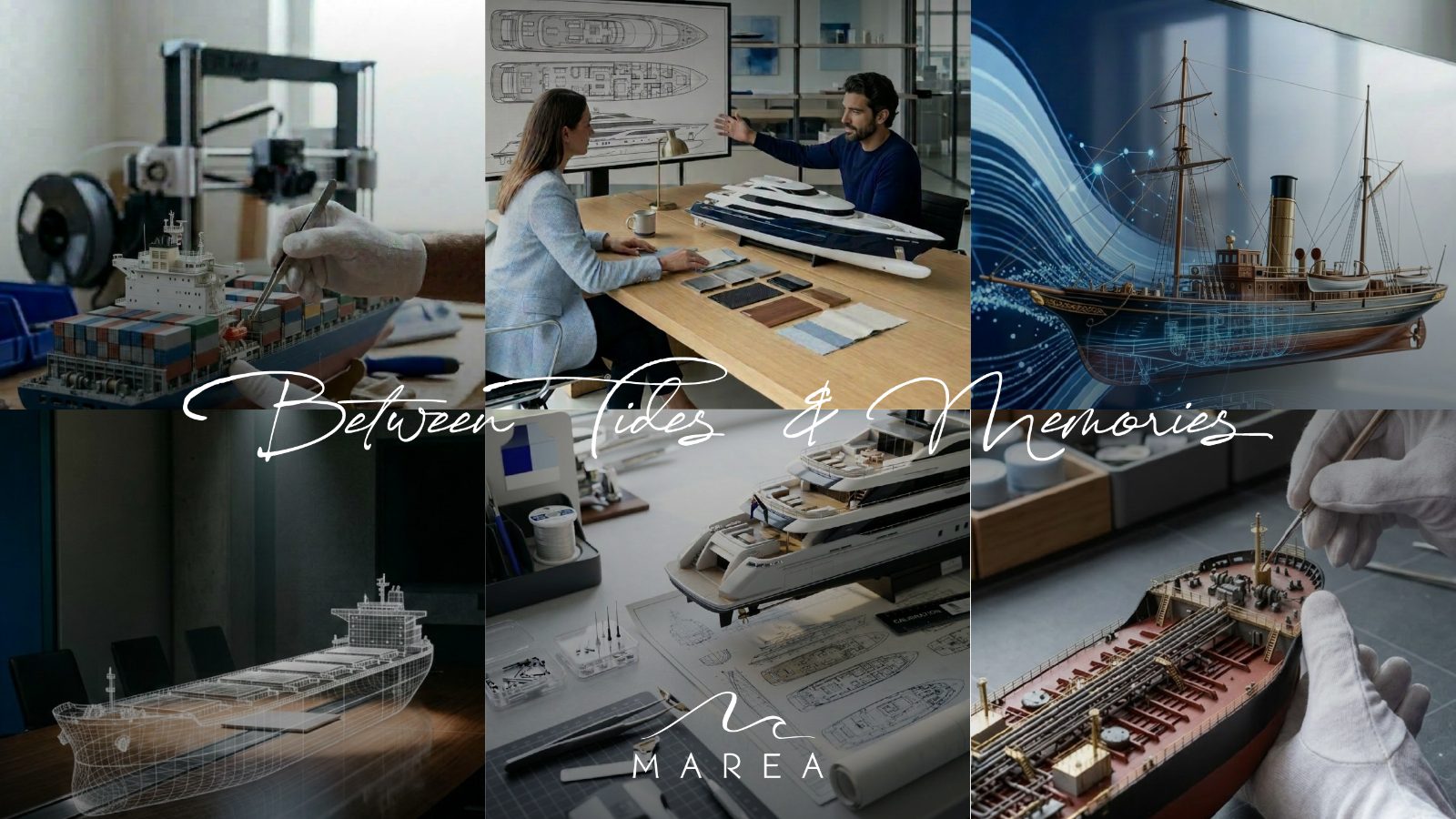
On why the essence of a scale model lives in its details, and why the finest detail of all is the one that turns a replica into memories.
There is a French expression that has followed me through this craft: belle de loin, mais loin d'être belle. Beautiful from afar, but far from beautiful. It is usually said of a thing that flatters at a distance and disappoints on approach, and it describes, with some precision, most of what passes for a scale model today.
From across a room, almost anything can look the part. A hull catches the light, a mast stands where a mast should stand, and the eye, generous by nature, fills in the rest. Distance is forgiving. Distance hides. The real test of a model is not whether it holds together at three metres, but whether it rewards you at thirty centimetres, when your eye travels along a deck seam, into the shadow of a companionway, across the fine geometry of a railing.
That is where a Marea begins to speak.
Bring your face close to one of our High Tide pieces and the model does not thin out or apologise. It deepens. The planking resolves into real planking. The fittings stay crisp where others lose definition, every one defined, correctly proportioned and exactly where it should be. The finish, seen at this distance, is not a coat that sits on the surface but a quality that seems to rise from within it. What looked beautiful from afar turns out, up close, to be beautiful still. The expression is quietly refuted.
This, in fact, is why every Marea is delivered with a magnifying glass. It is the least necessary and most deliberate object we could hand you, because the work does not ask to be forgiven under magnification. It asks to be met there. The glass is less a tool than a statement, an open invitation to come closer and to doubt us: to hunt for the seam that gives us away, the rivet set a fraction wrong, the rust that reads too evenly. You will not find much, and that is precisely the point. A magnifying glass placed in your hand is our quiet way of saying that the closer you look, the more there is to admire, and the less there is to forgive.
None of this is an accident of manufacturing, and none of it is the work of a factory. Marea is not a company run by a businessman counting units. It is a small circle of people who are, quite simply, in love with the objects they make, and who take an unhurried pleasure in getting the smallest things right. That pleasure is the whole point. It is also, I have come to believe, the only reliable route to detail that survives a close look, because detail of this order cannot be demanded on a schedule. It has to be wanted.
Wanting it, though, is not always enough. There is a hard problem at the centre of our craft, and it is a problem of translation. How do you take a full-size vessel, an object of enormous complexity, and reduce it many times over without losing the character that made it worth reproducing in the first place? Shrink everything faithfully and much of it becomes invisible, or impossible to make. Simplify carelessly and the soul goes out of the object. Somewhere between those two failures lies a single right answer for every rope, every rivet, every curve.
This is the question we built Ai Refloat™ to answer.
Ai Refloat is ours, conceived and developed in-house to push the finest detail further than the hand alone can reason about. Its task is to define, with a rigour we could never manage by eye at that scale, exactly how far a reduced-size object can be simplified while still reading as true to its full-size original. It studies where the eye actually looks, which lines carry the likeness and which merely add noise, and where a fraction of a millimetre earns its place. In doing so, it lets us hold on to the essence of a ship, a J-Class under full sail, a working detail on a classic hull, at sizes where essence is usually the first thing lost.
I want to be careful here, because it would be easy to misread what this means. Ai Refloat does not make the models. It informs them. It is a way of thinking harder about detail, not a way of removing ourselves from it.
When the digital work is done, and the geometry is as honest and as intelligent as we can make it, the piece still comes to a bench, and a pair of hands, and a pair of eyes. The finish remains ours. It is judged the way it has always been judged: by hand and by eye, by someone close enough to see everything the camera and the algorithm cannot feel. A line is sanded until it is right. A tone is taken back because it read a shade too warm in the light. The last quarter of the work, the part that decides whether a model is merely accurate or truly alive, is human, and it will stay that way.
And then there is one last pass, made after the model is technically finished, that matters far more than its size suggests. We weather it. By the same hand and the same eye, we lay in the faint marks of a life at sea, just enough to amplify le côté réaliste* without ever tipping into artifice. A subtle touch of rust along the stacked containers and heavy chains of a cargo ship. A pale salt-bleaching where the weather would have worked hardest. It sounds like a small thing. It is, in truth, the whole difference between a toy and a vessel. No one truly wants a brand-new container ship. A ship with no wear has no past, and a ship with no past has nothing to say. We want yours to carry a soul and a story, a presence that seamen and seawomen would know at a glance, because they have stood on decks that aged in exactly this way.
From there, the story stops being general and becomes entirely yours. Picture a bikini top left on the lounger of a yacht, sun-warmed and unhurried, as though its owner has just slipped below for a moment and will be back before the ice melts. Or something that reaches far deeper than charm: your late grandfather's captain hat, resting on the bar of a scale model of the sailboat he loved, set down exactly where he always left it. In that single object, the piece quietly changes register. It is no longer a replica of a boat. It becomes a portrait of a person, the keeper of an afternoon, a way of holding him near. This is the work we care about most, the moment a model crosses from craftsmanship into memory.
Belle de loin is easy. Anyone can manage beautiful from afar.
We care about the other distance. The near one, where a breath of rust tells its small truth and a hat left on the bar still remembers someone. It is the distance at which a model stops being an object and becomes a memory. That is where a Marea lives, between tides and memories.
Rezz
Creative Director
* le côté réaliste: French for "the realistic side", the quiet sense of realism that makes a piece feel lived-in rather than new.