
From the Creative Director
Museum Quality Ship Models
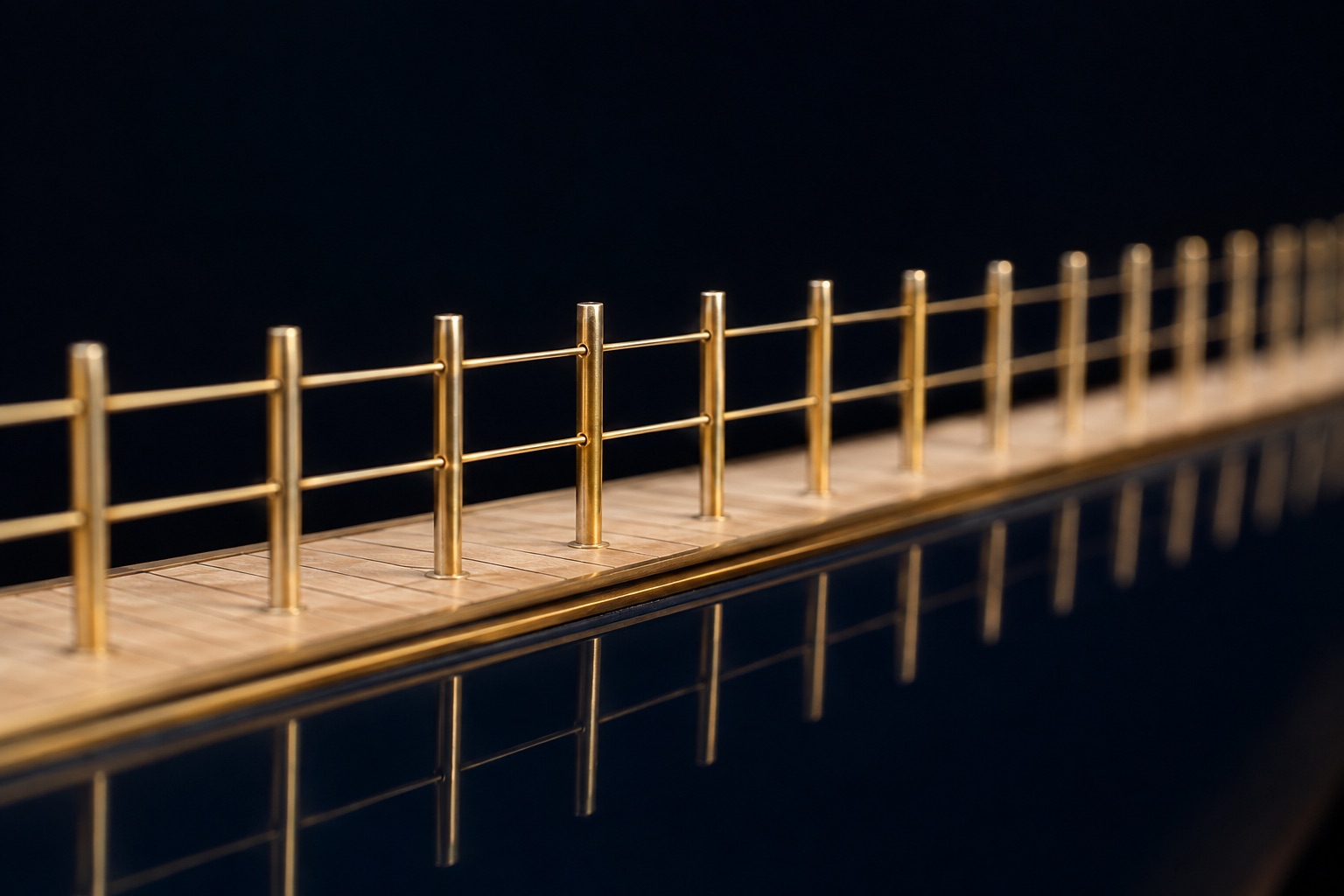
On the two most abused words in model making, what the term actually implies, and why we never use it.
Read a hundred listings for scale ship models and you will read the same two words a hundred times. Museum quality. You will find it above models that have earned it and, far more often, above models that have never been within a mile of a museum. It is used by builders, by dealers and by resellers who have never held a scalpel, and increasingly by software writing product copy for stock that arrives in bulk. The phrase has been repeated so indiscriminately that it now carries almost no information. It tells you nothing about the model. It tells you only that somebody would like to sell it to you.
There is a French line I keep returning to whenever the subject comes up: le temps ne respecte pas ce qui se fait sans lui.* Time does not respect what is made without it. It is the whole argument of this article, and by the end I hope it will read less like a proverb and more like arithmetic.
The term has a definition. Most of the people using it have never read it
Museum quality is not a compliment a maker pays himself. It is a classification, and it has been written down. The Nautical Research Guild set out classification guidelines for exactly this purpose, and the museums that keep such collections apply much the same thinking before they will accession a model at all.
What those standards deal with is not prettiness. They deal with documentary accuracy, with the sources the model is built from, with materials, with method of construction, with the level at which an object stops being a decoration of a vessel and becomes a record of one. Hold the average internet listing up against them and it does not fail narrowly. It fails completely. And in fairness to some of the sellers, they have very often never read the standard they are invoking. They inherited the phrase from the listing above theirs.
What museum quality actually is
Strip the marketing away and the definition becomes almost brutally simple.
A museum quality model is one built with no time limit and no budget limit.
Everything else follows from that single condition. Refinement follows from it: every surface worked until there is nothing left to take away, every finish laid, cut back and laid again until it stops sitting on the object and starts belonging to it. Discipline follows from it: alignments and spacings measured rather than judged by eye, porthole runs even from stem to stern, stanchions plumb and equidistant, plank widths consistent, deck fittings squared to the centreline and to each other, because at this level a fraction of a degree is a defect and not a charm.
Materials follow from it. Noble timbers chosen for grain at scale rather than for cost, boxwood, pear, holly, ebony. Brass and copper, worked, soldered and blackened rather than cast and hoped for. Planking laid plank by plank with its caulking lines, decking laid the same way and not printed. Rivets that are rivets. Pins that are pins. Fittings turned and fettled by hand, one at a time, in quantities that would make a production manager ill.
And honesty follows from it, in the parts nobody will ever see. On a museum piece, the structure under the finish is made properly too, because the standard is not what survives a photograph, it is what survives a curator.
Every one of those things is a purchase of time.
The arithmetic nobody wants to do
Put a model like that on a bench and it will hold a skilled pair of hands, on and off, for the better part of nine months. Not nine months of project duration. Nine months of somebody’s working life spent on one model, most of it in the last twenty percent of the work, which is where finish and alignment live and where nothing can be hurried.
Price it honestly, at haute craftsmanship man-hours and materials of that grade, and you arrive somewhere between $25,000 and $60,000, depending on the vessel, the scale and the complexity of her rig. That is not a luxury margin. That is the bill. Hours, plus material, plus the trade of a person who has spent thirty years learning to make the last half hour of a surface look like no time was spent on it at all.
Now hold that number next to the offer you have actually been reading online. Museum quality, three months, a few thousand…
Do the division. A price like that, spread over the hours the standard requires, implies an hourly rate that no trained artisan in Europe, or anywhere else with a cost of living, could accept. So one of two things is true. Either the hours were never spent, which means it is not a museum quality model. Or the hours were bought somewhere they cost almost nothing, in a workshop the seller will not name, by people paid in a way none of us would want examined. There is no third option, and no amount of tooling closes a gap of that size, because tooling accelerates geometry and it does not accelerate patience.
This is why the lowest price in this field is never a bargain. It is a disclosure.
Builders, and people who sell what builders make
The other tell is stock.
A genuine model builder works to commission. He builds your vessel, in your scale, to your brief, and he keeps nothing on a shelf, because everything he makes already belongs to somebody. If a museum quality model is in stock, photographed on a white background and ready to ship on Tuesday, it was not built for you, and it was very probably not built by the person selling it to you.
A great deal of what is sold as museum quality is bought in volume from mass production workshops in the Far East, marked up several times over, and passed on with an inflated price and a borrowed phrase. At two metres such a model resembles the ship. It does not survive one minute of scrutiny. The proportions are approximate, the fittings are generic, the detail is thick where it should be fine, and it has no collector’s value whatsoever, because there is nothing in it that a collector is actually buying.
Belle de loin, as I have written before. Beautiful from afar.
Why you will not find the phrase on our website
We do not say museum quality at Marea. Not on the site, not in a proposal, not in a quote. It is not modesty. It is that the phrase has been spent, and I would rather describe what we actually do than borrow a term that no longer means anything.
We do build to that standard when it is asked for. A museum quality commission is a real thing and we will take one on. But it is made on request only. By default we do not quote for it, we do not suggest it, and we do not slip it into a proposal as a flourish. When a client asks for it, we quote the truth: the months, the money, and what both of them buy. If the answer is nine months and a number with five figures, that is the answer. A quotation that promises the standard without the time is not a quotation, it is a trick.
I should be exact about one thing here, because it would be easy to accuse me of the very sin I am describing. We tell clients we deliver in one to two months where the industry quotes three. That is true, and it is not a contradiction, because of what we compress and what we refuse to compress. Modern fabrication genuinely accelerates the digital and mechanical part of the work: the modelling, the iteration, the tooling, the cutting, the coordination of a studio that would otherwise be waiting on itself. It does not accelerate the hand. Finish, weathering, fettling and the final eye take what they take, and we do not shorten them. And we still do not call the result museum quality, because it is not. It is High Tide, and that is a different claim, made honestly.
How close you can get without paying for it
High Tide is the closest you will come to a museum piece without commissioning one.
The whole intention of the range is the maximum detail the scale permits, finished to be inspected rather than admired from the doorway. What makes that possible at a sane budget is Ai Refloat, and it earns its place in two ways that are worth separating.
The first is that it finds the ceiling of the scale. For any given size there is a limit to how fine a component can be and still be made, still be assembled, still survive being handled and dusted for thirty years. Working that limit out by eye and by experience costs weeks and still leaves you guessing. Ai Refloat establishes it, so we build to the edge of what the scale allows instead of stopping comfortably short of it, and the hours we save are hours the bench gets back.
The second is more interesting, and I want to be careful about how I put it, because it comes very close to the sin I have spent this article condemning.
Below a certain scale, some details cannot be reproduced faithfully. A handrail rendered at true scale at 1:200 is thinner than a hair, unmakeable, invisible, and gone at the first touch of a cloth. Every maker meets this problem. The dishonest answer is to thicken everything to whatever is convenient, hope nobody measures, and call it museum quality. The considered answer is to know precisely what the true dimension is, decide the smallest possible departure from it, and apply that departure only where the eye needs the line to survive. Out of scale on a ruler. True to scale to the eye.
That is the distinction between a rail which scales up to a 150mm steel bar because it was easier to make, and a rail held a hair over scale because at that size the alternative is no rail at all. One is a corner cut. The other is a decision, taken deliberately, and Ai Refloat is how we take it with numbers rather than with a shrug. The result is a model that reads as truer than a strictly faithful reduction would, which is the entire trick of the thing, and it is the only place in our process where we allow ourselves to be wrong on purpose.
À l’œuvre on connaît l’artisan
By the work one knows the craftsman.** You cannot know him by his adjectives, and after twenty years around brands I can tell you that the loudest claim in any category is usually the one doing the most work to cover something.
So ignore the phrase. Ask the questions it is standing in for. How many hours are in it. Who put them in, and where, and what were they paid. What is the hull made of, and the deck, and the fittings. Is the planking laid or printed. Was it built for me or bought in. And if it is museum quality, may I see the standard you are measuring it against?
A maker who has done the work will enjoy those questions. We do. It is why every Marea leaves the studio with a magnifying glass, which remains the least necessary and most deliberate object we could possibly hand you.
We will not tell you our models are museum quality. We will hand you the glass and let you decide what they are.
Chaque détail compte.***
Rezz
Creative Director
* le temps ne respecte pas ce qui se fait sans lui: French, “time does not respect what is made without it.”
** à l’œuvre on connaît l’artisan: French, “by the work one knows the craftsman.”
*** chaque détail compte: French, “every detail counts.”