
The Connoisseur's Eye
How to Judge a Scale Model Up Close
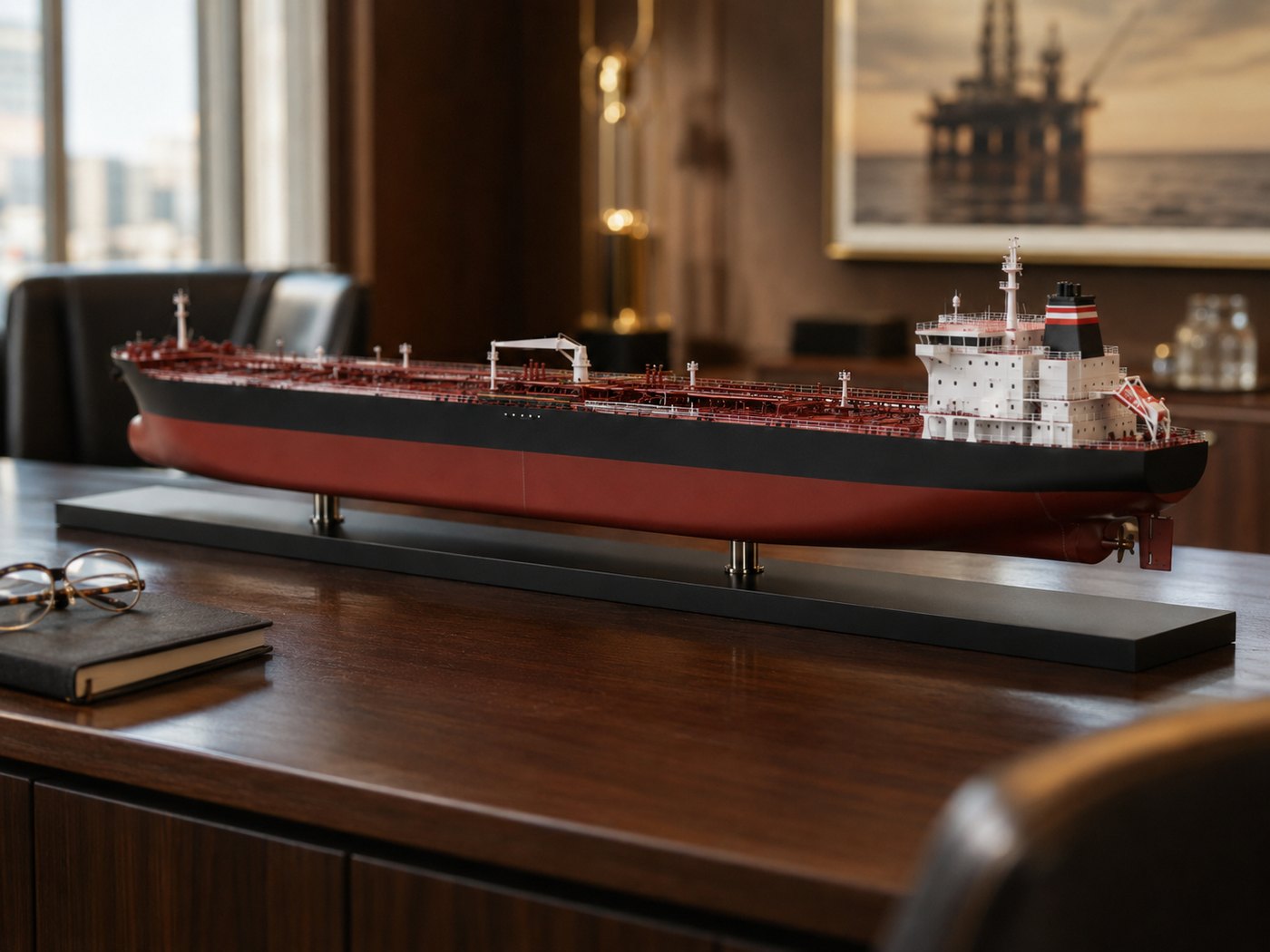
The French have a phrase for something that flatters at a distance and disappoints up close: belle de loin, mais loin d'etre belle, beautiful from afar, but far from beautiful. A scale model is exactly the kind of object the saying was made for. At arm's length almost anything reads as impressive. The quality, or the want of it, lives in the details you only see when you lean in. If you are commissioning a model, or simply judging one, here is how to look at it the way a maker does.
Symmetry and alignment
Sight straight down the centreline, from the bow and again from the stern. The portholes, the hublots, should sit at the same height and the same spacing on port and starboard, and each run should be even rather than creeping closer together towards the ends. Stanchions and handrails should stand plumb and equidistant, the rail itself a fair, continuous line with no kinks or sags between posts. Companionway and accommodation-ladder steps should have equal risers and sit truly parallel. Deck fittings should align to the centreline, or to one another, and not wander. Misalignment is the first fault a trained eye catches and the hardest to forgive, because it is rarely a single slip; it tells you about the care taken across the whole build.
Proportion, against the real vessel and against the scale
This is where a specialist separates a true scale model from a mere likeness. Take the model's principal dimensions, length, beam, and height to a known point such as the deck or a masthead, multiply them by the stated scale, and compare the result with the real vessel's registered figures. They should agree, not merely look about right. Then check that the detail is held to the same scale as the hull, because this is where corners get cut. Railings, rigging, ladders and handrails are the usual giveaway, rendered two or three times thicker than scale because anything finer was too difficult to make. A handrail that would scale up to a 150mm steel bar is not a handrail, it is an apology for one.
Angles and rake
Many vessels are defined by a handful of angles: the rake of the stem and the flare of the bow, the angle of the transom, the rake of the masts and the funnel, the steeve of the bowsprit. Get one of these wrong and the character of the ship is lost even when every individual fitting is present and correct. Compare them against a good broadside photograph; the eye reads rake remarkably accurately once it knows to look for it.
Fairness of the hull
Run your eye, and if you are permitted, your hand, along the hull, and sight it against a window or a lamp. It should be fair: a smooth, continuous curve with no flats, hollows or ripples, the waterline crisp and dead level, the boot-top an even width along its whole length. Unfairness hides from a straight-on view and shows itself in a reflection, which brings us to the most revealing test of all.
Finish, read in raking light
This is the connoisseur's trick, and it costs nothing. Tilt the model, or move a light, so that the light rakes low and almost flat across the surface. Raking light exposes everything a face-on view conceals: ripples in a hull you had judged fair, brush marks, the faint orange-peel of a hurried spray finish, sanding scratches sealed under the lacquer, a speck of dust or a stray bristle trapped beneath a coat. On gloss surfaces the reflection itself is the instrument: a fair, well-finished surface returns an undistorted reflection, while a poor one bends and ripples it. While you are close, check the small disciplines too, clean colour separations with no bleed, no glue bloom haloing the fittings, no fingerprints sealed under the clear coat.
The details that betray haste
None of the following is fatal on its own, but together they tell you how the maker worked: a speck of sealed-in dust, a join sitting slightly proud, a porthole ring not quite concentric, a flag moulded as stiff as a board. A fine model survives this scrutiny not because it is flawless under a microscope, but because the discipline runs all the way through it, from the hull form down to the last handrail.
We build to be looked at this closely
Everything above is the standard we hold our own work to, which is why we are glad when a client applies it. It is also why the High Tide range is delivered with a magnifier: not as a flourish, but as an invitation to hold the model to exactly the scrutiny described here and find that it holds. We would always rather you inspected a Marea model than took it on trust.
If you are weighing a commission, bring your most demanding eye. That is precisely the standard we build to. Write to us at wave@mareascalemodels.com, or request a quote, and we will be glad to talk through it.