
Care and Conservation
Caring for a Scale Model: A Conservator's Approach to Everyday Display
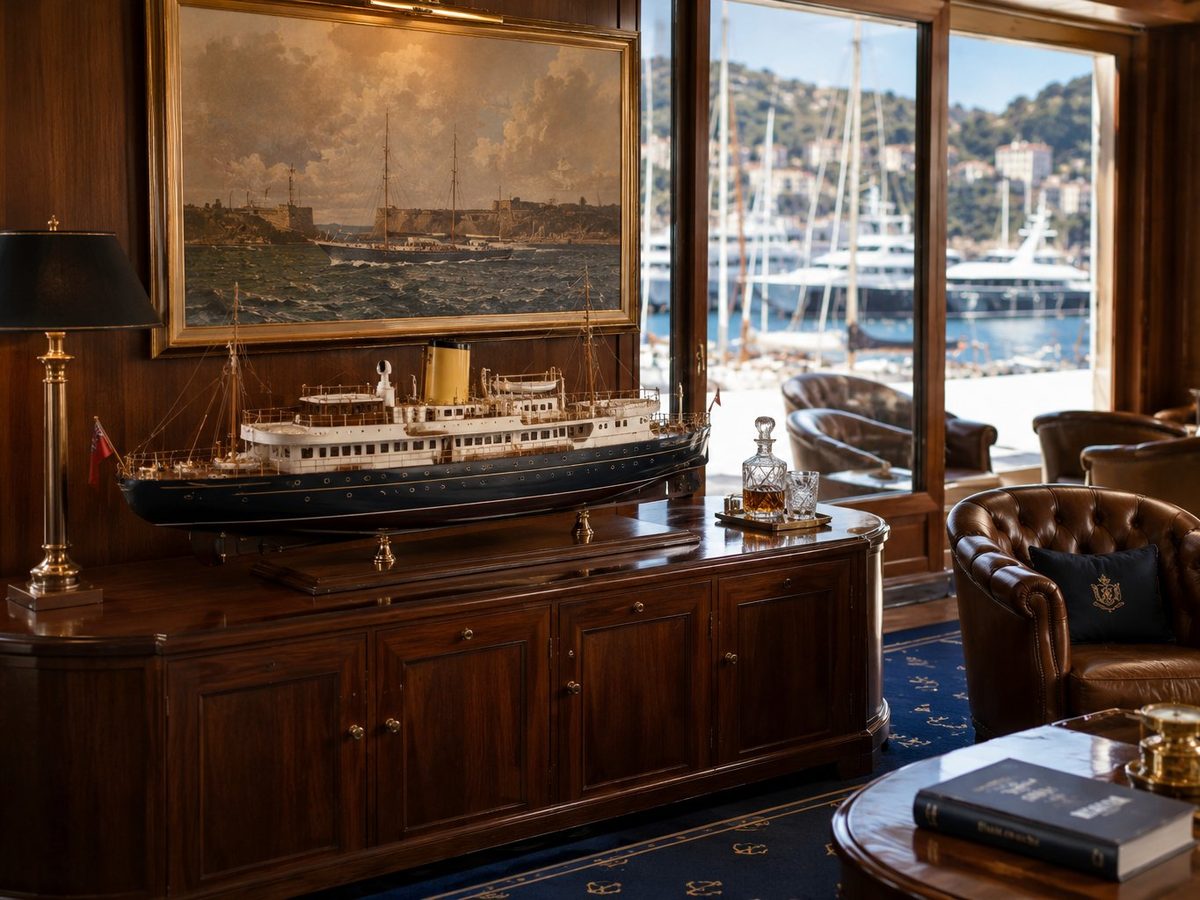
A well-built model does not deteriorate with age. It deteriorates with its environment. Light, heat, dust and swings in humidity are what dull a finish, fade a deck and loosen a joint, and every one of them is within your control. The standards below are essentially the ones museums apply to their own ship-model collections, adapted for a home or an office rather than a climate-controlled gallery.
Light
Ultraviolet light is the enemy of any painted, varnished or timber surface. It bleaches hulls, yellows clear finishes and fades decks, and the damage is both cumulative and irreversible, so there is no recovering it later. Keep a model out of direct sunlight entirely, not merely out of the midday sun. Where the piece is lit, use LED lighting in the warm range of 2700 to 3000K, which gives a natural, flattering light without the ultraviolet output of halogen lamps or daylight. A good acrylic case blocks well over 90 percent of UV while remaining optically clear, which is one of several reasons we favour it over open display.
Heat
Heat does its damage indirectly, by driving the humidity cycling described below. Keep a model and its case at least two metres from any radiator, fireplace, underfloor-heating run or warm-air vent, and never stand one on top of an appliance that heats up. A steady temperature in the region of 18 to 22°C is ideal. What matters even more than the figure is that it does not swing quickly: a stable cool room is kinder than a warm room that lurches up and down.
Humidity
Timber, cordage and many adhesives are hygroscopic. They take up and give off moisture as the surrounding air changes, swelling and shrinking very slightly each time they do. Hold the relative humidity steady, somewhere between roughly 45 and 55 percent, and you remove most of the internal stress that eventually cracks a hull or springs a joint. A sealed or semi-sealed case with a small silica gel pack inside buffers the air beautifully; it changes far more slowly than the room around it. Regenerate or replace that gel every three to six months, depending on your climate. The two states to avoid are the extremes: a bone-dry, centrally heated room in deep winter, and a damp, unventilated one.
Dust
Dust is mildly abrasive, and it traps moisture against the surface it settles on. Remove it with a soft natural-hair brush, sable or goat rather than synthetic, or with a hand blower of the kind used for camera sensors. Never reach for a canned-air duster: the propellant leaves the can cold enough to shock and craze a lacquered surface. Work from the top down, support the model as you go, and brush along fine details such as railings and rigging rather than across them, where a stiff bristle can bend photo-etched brass.
Hull, rigging and fittings, each handled differently
A barely damp microfibre cloth, followed immediately by a dry one, is acceptable for lifting a fingerprint or a mark from a painted hull. Never take a damp cloth to rigging or sails: thread and fabric hold the water, then sag and stain. Treat photo-etched railings and fine brass as the delicate things they are, brushing along their length, never across. When you need to move the piece, lift it by its baseboard or by the solid of the hull, never by a mast, a rail, a davit or a bowsprit, and consider cotton gloves to keep skin oils, which are acidic, off bare brass and paintwork.
The case itself
A display case should sit at least 20 percent larger than the model on every side. That margin is not only for presentation; it lets air move around the hull so that moisture never condenses against it, and it keeps the glass or acrylic clear of delicate fittings. Position the case as you would the model: out of the sun, away from heat, in the steadiest corner of the room.
Treated this way, a fine model comfortably outlives its first owner and passes on with its detail intact. If you would like guidance specific to your own Marea piece, the particular timber, finish and rigging we used for it, write to us at wave@mareascalemodels.com and we will set it out for you.