
From the Creative Director
How to Choose a Scale Model Company
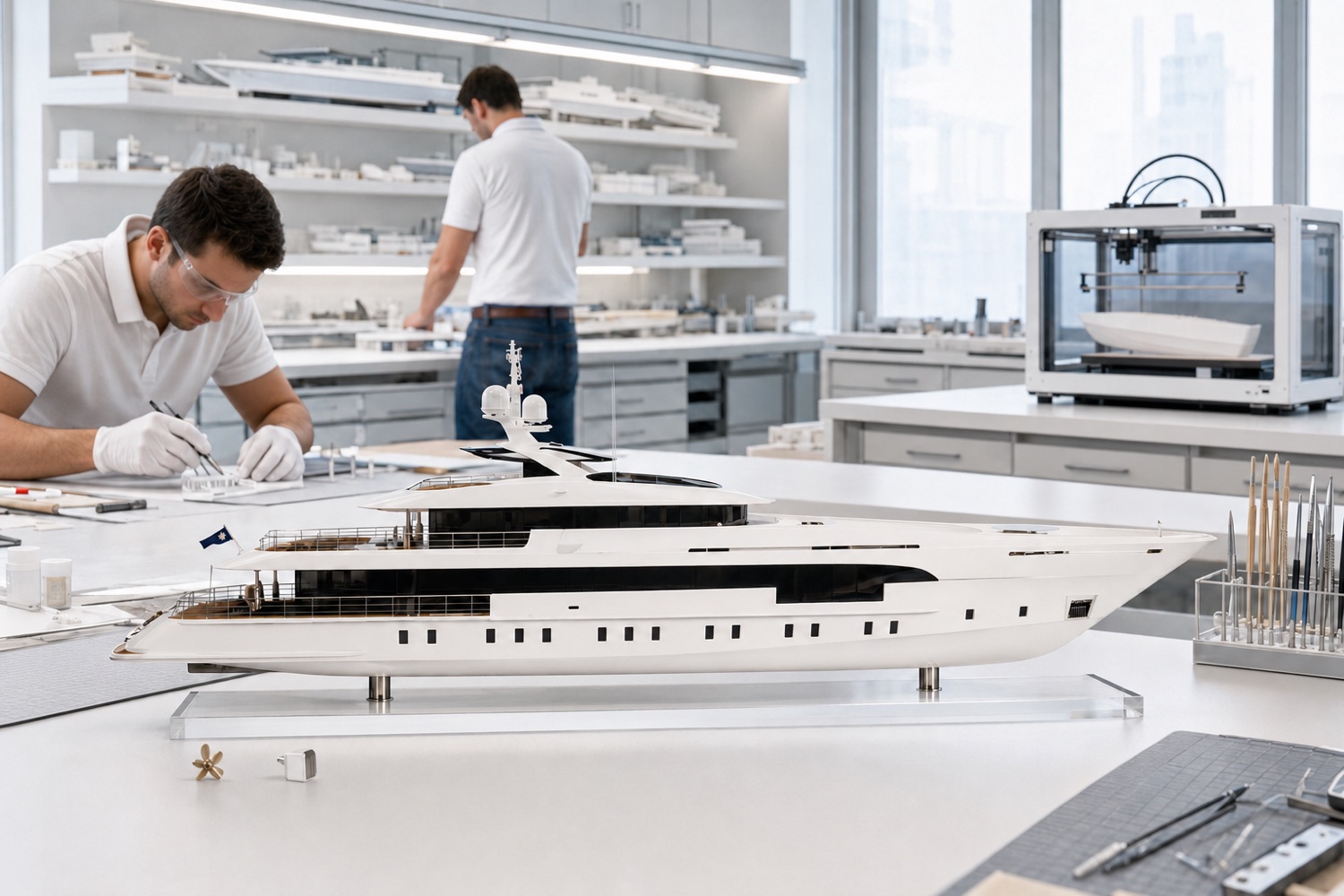
Search for a scale model company online and you will have twenty websites saying the same thing: handcrafted, bespoke, every detail, decades of experience, any vessel at any scale. The photographs are lovely and the words are interchangeable.
Worse, on nearly every site you will find the promise of museum quality, a phrase used so freely now that it has stopped meaning very much. I have written a whole article on what museum quality really demands, and very few of the models sold under that name would pass it.
Hardly any of these websites tell you what you actually need to know, which is how the model is going to be made, by whom, and with what care. The one thing that should decide your choice is left vague, on purpose.
Look a little closer, though, and they fall into four broad types. Each of them can make a good model of a specific kind. However, most bad commissions begin when a client takes one type of model to the wrong type of company. The mistake usually stays hidden until the model is unveiled.
So here is a map of the field, an honest account of where we sit in it, and a checklist you can take into any conversation, including one with us.
The shop with a workbench at the back
The first is the hobby shop that also builds. You will recognise it by the catalogue: hundreds of ships, cars and aircraft, sometimes thousands, most of them entry-level kits and ready-made models, with a custom-building service carried out somewhere in Mauritius, India, Vietnam or the Philippines. Sadly, cheap labour does not rhyme with finesse.
- The catalogue is the business. Stock models and kits sold by the hundred, with bespoke work as one service among many.
- Entry level by design. The range is priced to sell in volume, and its finish and detail are set accordingly.
- Where a custom build starts. Ask whether it begins with the drawings of your vessel, or with the nearest model already in the range.
- Who actually builds it. Some of these shops have their own builders; others pass custom work to a workshop in a country with cheap labour. Ask which, and where.
The company that makes everything
The second will build absolutely anything. Cars, aircraft, ships, trains, weapons, architectural models for a property developer, a product prototype for a trade fair. Its portfolio is enormous and genuinely impressive, until you notice how few of the pictures show anything like the vessel you have in mind.
The French have a proverb for it: qui trop embrasse mal étreint,* whoever embraces too much holds on badly.
- Read the list of sectors on the home page. If ships sit somewhere between architecture and medical equipment, you know roughly how much of the company’s attention they get.
- A portfolio that runs from a sports car to a shopping centre to a frigate, with only a handful of ships among them.
- A team organised by machine or material, rather than by subject, so the person shaping your hull may have spent last week on a stadium.
- Nobody who knows the ship. Ask how the manifold of a tanker is laid out, or why the sheer of a 1930s motor yacht differs from a modern one, and listen to the pause.
- Ships treated as a shape to be copied, when every detail on a real vessel is there because of what she does.
- Ask them: how many models of this type of vessel have you built in the last two years, and may I see them up close?
The hammer
The third has one method and uses it for everything. Abraham Maslow wrote the idea down in 1966: give a man only a hammer and everything begins to look like a nail. In model making the hammer might be a 3D printer, a CNC router, a casting shop, or a pair of hands that only knows timber. Whatever it is, every part of every model gets made with it.
- The whole model in one process. Hull, railings, davits and glazing all printed in the same resin, because the printer is what the company owns.
- Or everything in wood, including fittings that on the real yacht are polished stainless steel and ought to read as metal.
- Railings as thick as the process allows, and portholes painted on as circles, because the one method cannot make them glazed.
- A material chosen by the equipment in the room, when it should be chosen by the part.
- Ask them: how is the hull made, how are the railings made, how is the glazing made? If the answer to all three is the same word, you have found the hammer.
Every skill under one roof
The fourth is the most common, the most convincing and the hardest to see through. Nearly every serious maker in the field says it in one form or another: every skill under one roof. It usually comes with a real workshop, real craftsmen and a decade or two of history. What the phrase leaves out is that the same hands, with the same techniques, will build a historic sailing ship, a modern superyacht and an LNG carrier in much the same way. I wrote about this in the article on tankers and gas carriers: workshops that spent twenty years on historic wooden ships and turned to technical models because that is where the market went.
- A house style you can spot across the whole portfolio, whatever the vessel, which is charming on a frigate of 1780 and wrong on a gas carrier.
- One way of doing each thing. One way of making a handrail, one paint system, one finish, applied alike to a 1:50 sailing yacht and a 1:200 FPSO.
- Skills that are broad rather than deep, because a single workshop rarely holds the best casting, the best printing, the best joinery and the best paint all at once.
- Yesterday’s machines. Printers and tooling bought a few years ago have to keep working until they have paid for themselves, whatever has arrived on the market since.
- Historic craft on a technical vessel. Beautiful planking, and a manifold that nobody on the client’s side will recognise.
- Ask them: what will you do differently on my vessel compared with the last three you built?
Where Marea sits
In none of the four, and that was decided before we made anything.
There is an old French saying that puts it better than I can: à chacun son métier, et les vaches seront bien gardées,** to each his own trade, and the cows will be well looked after. It is a farmer’s proverb, and it is the whole of our method.
- A design studio, in house. An engineer and a creative director work together on every commission from the drawings up: the research, the 3D model, the technical decisions and the brief. That part is never sub-contracted.
- A specialist for each technique. Each part is then made to our design by a supplier who does one thing and has spent years perfecting it. 3D printing, metal casting, timber, resin and so on, each with its own specialist.
- The latest technology, without the debt. Fabrication technology is moving faster than we have ever seen it move. A workshop that owns its machines is tied to them until the investment has been returned, and cannot replace them every time something better appears, so it goes on making models with the equipment it could afford when it last invested. A supplier who does one thing, and does it perfectly, has every reason to do it on the newest equipment there is. That is why we prefer specialists.
- 3D printing at 30 microns, with no print lines. Our printed parts carry detail as fine as 30 microns, under half the width of a human hair, and none of the stepped lines that give a printed model away.
- Metal cast by casting specialists. Where a fitting should read as metal, it is cast in metal by a supplier whose whole trade is casting.
- The method follows the part. A railing is made the way a railing is best made at that scale, and a hull the way a hull is best made, even when that means two different specialists.
- Assembly, finish and quality control, in house. Every part comes back to us, to our own team of traditional model makers, whose speciality is assembly and finish. They assemble, paint and finish the model by hand, and it is inspected against the brief and the approved renders.
- Control at both ends. The usual argument against outside specialists is that detail gets lost between one pair of hands and the next, and it is a fair argument. Our answer is to hold both ends. We control the input through design, so every part leaves the studio fully specified in the brief. We trust our suppliers with the making, because making that one thing is what each of them does best. And we keep assembly and finish under our own responsibility, because the finesse of the finish is what you will live with, and we will not hand control of it to anyone else. Every part comes back to be checked before it goes anywhere near the model.
- A budget line, made the traditional way. When a client needs a model at a lower price, we work with model makers in Vietnam and the Philippines who build traditionally, by hand. It takes three to four months and costs far less. We chose these workshops carefully, not only on price but on the quality of what they build and on how well they follow instructions. When a model is being made on the other side of the world, the biggest threats to it are miscommunication and misunderstanding, an instruction read one way in our studio and another way at the bench.
- The same standard either way. We make sure the budget model is aligned with Marea’s standards before it reaches you, and we tell you plainly where and how it was made. I have written before about models bought in from workshops the seller would rather not name. The difference here is that we name the arrangement and stand behind it.
One more thing, since the others are sure to mention it before we do. We do not have ten or twenty years of history behind us. Marea is a young company, and we are taking the very first steps of our legacy now, one commission at a time. That gives us every reason to make each model perfect, because every model we deliver becomes part of the reputation we are building, and we intend that reputation to be clean and respected from the very first.
Now the checklist. Three requests come first, because together they will tell you more than anything a company can say about itself.
Ask for a model maker’s brief
A model maker’s brief (MMB) is the document that sits between the design and the build. It sets out what will be made, how, at what scale and to what tolerance, and it is what the client signs before anything is cut. Ask every company you are considering for an example from a previous commission.
- Does one exist at all? Plenty of models are built from an email thread and a few photographs. If there is no brief, there is nothing to hold the model to when it arrives.
- Depth. A well-developed brief, of the kind we write, runs to between 40 and 50 pages. A two-page quotation with a sketch attached tells you how much thought has gone into your model so far.
- Dimensions and arithmetic. The principal dimensions, the scale, the real size of the key details worked out at that scale in millimetres, and the tolerance each part is held to.
- A method for every part. Which parts are printed, cast, turned, etched, carved or planked, and in what material.
- Departures from scale, stated and agreed. Where a detail is too fine to make at true scale, a good brief says so, says by how much it will be thickened, and says why.
- Colours by reference. A paint code, a RAL number or a painted chip, never simply “navy blue”.
- Samples and approval points. Which parts you will see and approve before assembly, and when.
- Structure. Numbered sections, revisions dated, open questions listed as open. A brief that admits what it does not yet know is worth more than one that pretends to know everything.
- A signature page. Somebody has to put their name to it, on both sides.
How a company writes its brief is how it will build your model. A vague document produces a vague model, and a deep, orderly one tells you there is a deep, orderly studio behind it.
Ask how each part will be made
Then take the brief, or the quotation if there is no brief, and ask one plain question of every major part of the model: how will this be made, and by whom?
- The hull. Carved, planked, moulded, cast in resin or printed? In one piece or several, and how are the joins hidden?
- The deck. Planked by hand with real caulking lines, laser engraved, or printed with the lines already in it?
- Superstructure and glazing. Are the windows glazed, or painted?
- Railings and stanchions. Etched brass, turned metal, wire or printed, at what thickness, and against what true-scale thickness?
- Fittings. Winches, cleats, davits, anchors, deck machinery: cast in metal, printed, or taken from a kit maker’s spares box?
- Paint and finish. Which primer, which paint system, how many coats, and how they are cut back between them.
- The base and the case. What they are made of, and who makes them.
- Anything made outside. If parts come from outside suppliers, who specifies them, and who checks them when they come back?
And listen for the warning signs.
- The same answer for every part. That is the hammer again.
- “Handmade” offered as an answer. It is an adjective, and you asked about a method.
- “Trusted partners”, with no account of what each one makes or who checks it. Outside specialists are no cause for alarm. Not knowing what they do is.
- A promise to find out, which usually means the decisions are being made somewhere you cannot see.
Ask to see the workshop, and the paint booth
Almost nobody in this field publishes a photograph of a paint booth, which is exactly why it is worth asking for one. Ask for recent pictures of the workshop and, above all, of the booth, ordinary ones taken on an ordinary day rather than the brochure. Paint is where a model is won or lost, and paint is ruthless about its surroundings.
- Cleanliness. Dust on the benches is dust in the finish. Every speck in the air of a paint room is a speck waiting to be sealed under the clear coat, where it stays for the life of the model.
- Light. In a bright, evenly lit workshop, faults are seen and put right at the bench. In a dim one, they are discovered in your living room.
- A proper booth. Extraction, filtered air and a clean place to spray, rather than a corner of the store.
- Order. Parts labelled, stored and covered between coats. Your railings drying next to somebody else’s sanding dust is a bad sign.
- Gloves. Look at the hands in the photographs. Skin carries oil, and every bare fingertip leaves a little of it on a cleaned or primed part. Paint does not bond properly over it, and a print can show through the finish and stay there for good. Ask whether parts are handled in gloves from the moment they are cleaned until the last coat has cured.
- The parts themselves. If the pictures are close enough, look for smudges on primer or a dull fingerprint on bare metal. That damage was done before a drop of colour went on.
Before you pay a deposit
The rest of the list is shorter, and every item on it deserves a straight answer.
- Built for you, or bought in? If the model is in stock, photographed on white and ready to ship next week, it was not built for you.
- Who exactly will build it, and where? You are entitled to know, whatever the answer is.
- Comparable work, close up. Photographs of a model of the same kind of vessel at a similar scale, taken near enough to see the railings. A beautiful portfolio of other subjects tells you very little.
- Questions coming the other way. A good maker interrogates your references and asks what the model is for, where it will stand and who will look at it. One who simply sends a price will fill the gaps with guesses.
- One named person. A single contact who carries the project from the first call to delivery, so nothing is lost between departments.
- Renders before anything is cut. Will you see the model in 3D, at the agreed scale, and will it be built to match what you saw?
- Samples before assembly. Will you approve colours and the most delicate parts in your own hands, under your own light?
- Changes, and what they cost. Before assembly, a change is a conversation. After assembly, it is a repair. Ask where that line falls, and what crossing it costs.
- Progress you can see. Photographs and videos at agreed stages, rather than a single picture at the end.
- A price you can divide. Ask what the number is made of. If it implies an hourly rate nobody could live on, the hours were either never spent or spent somewhere the seller would rather not mention. Ask which.
- “Museum quality”, with no standard named. The phrase is everywhere and almost no one defines it. Ask which standard, and measured by whom.
- An honest date, in writing. Give the real date you need the model for, and ask how much margin is built in on their side.
- Packing, insurance and delivery. Who packs it, who insures it in transit, and what happens if it arrives damaged.
- Care afterwards. Will they tell you how to look after the particular timber, metal and finish they used?
None of these questions is difficult, and a maker who has done the work will enjoy every one of them. We do. Ask us for a brief, ask us how each part is made, ask to see the paint booth. Then ask the others the same things, and compare the answers rather than the websites.
Write to us at wave@mareascalemodels.com, or request a quote, and we will be glad to talk it through.
Chaque détail compte.***
Rezz
Creative Director
* qui trop embrasse mal étreint: French proverb, “whoever embraces too much holds on badly.”
** à chacun son métier, et les vaches seront bien gardées: French proverb, “to each his own trade, and the cows will be well looked after.”
*** chaque détail compte: French, “every detail counts.”