
From the Creative Director
Scale Models of Tankers and Gas Carriers: Engineered, Not Just Scaled Down
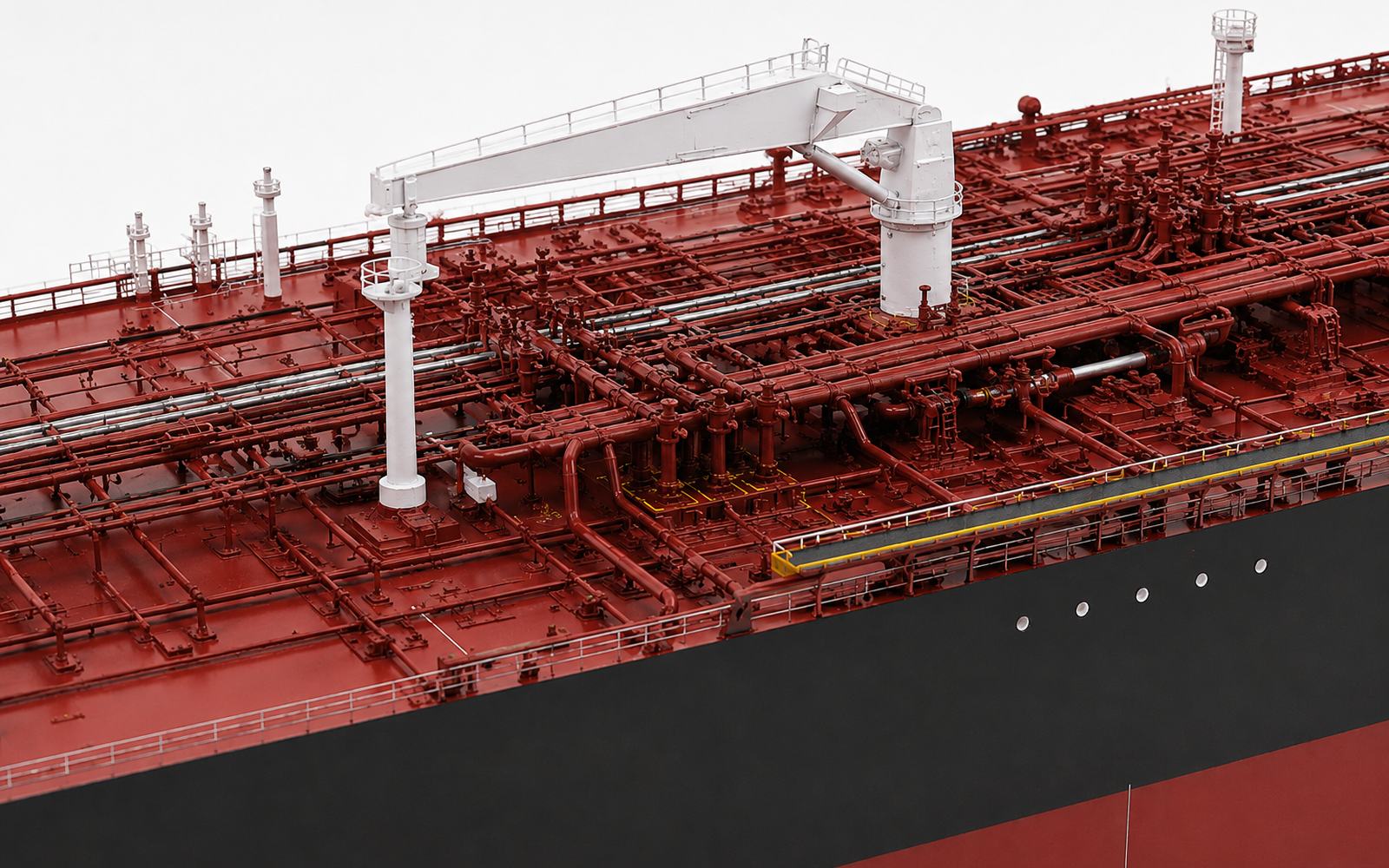
On what an oil and gas audience actually looks at, why one technical error kills a beautiful model, and why we work to thirty microns.
A scale model of a tanker or a gas carrier is judged in about ten seconds.
Not by a general public. By a chief officer who has walked that deck for fifteen years, a cargo engineer, a loading master, a technical superintendent from the owner's newbuilding team. They come up to the table at the naming ceremony, and before anybody has finished shaking hands, they have formed an opinion.
So, the difficulty is not making a beautiful model. Beautiful is comparatively easy. It is making one that survives people who know the vessel far better than the person who built the model ever will. Which is why scaling down a ship is an engineering exercise before it is a sculptural one.
Avoir le compas dans l’œil
There is a French expression for the faculty those people are using: avoir le compas dans l’œil.* The Académie française defines it as measuring accurately without the help of any instrument. To have a pair of dividers in your eye.
Everybody who works around ships has it. A chief officer does not need a tape measure to tell you a manifold is sitting too high. A process engineer does not need a drawing to see a module has too few bays. They cannot always explain what is wrong, and that is the interesting part. The eye reports the error long before the mind can justify it, and the model is quietly demoted before a word is spoken.
So, the expression describes the judge. It does not describe us.
Because I do not want a model of a gas carrier to be the product of a good eye. A good eye is where we finish, not where we start. What I want is the older and harder half of the same French idea: faire tout par règle et par compas.** To do everything by ruler and by drawing compass. With exactness. The Académie lists both in the same entry, and the difference between them is the difference between a decorative model and an accurately technical one.
Where most model makers stop
I am not about to dismiss finish. Finish matters enormously.
A soft edge, a seam that shows, a colour half a tone off, a rail that wanders over its run: those things are read. The model stands in your lobby, under your name, with your funnel mark on it, and its level of detail is taken, fairly or not, as a statement about how your company works. Nobody says so out loud. Everybody registers it. Finish is your image.
But finish is also where most model makers stop, and stopping there is exactly how they fail. They become genuinely good at making a beautiful object and never ask the question that decides whether it works, and to whom. They deliver to the client's eye and never to the client's industry.
And here is the mechanism. A beautiful model with one technical error does not survive the room. The error becomes the talk of the moment. Somebody points at the manifold. Somebody leans in. Within a minute four people are working out what is wrong, and that conversation is now the thing that happened at your ceremony, or on your exhibition stand.
The beauty does not defend itself. It evaporates. Nobody afterwards says the finish was superb but the vapour connection was on the wrong side. They say the model was wrong, and weeks later that is still the sentence.
So, they are not equal, and it is not close. Finish wins you the first glance. Accuracy is what survives long term. And no quality of finish has ever rescued a manifold in the wrong place.
What that audience is actually looking at
The eye does not go to the bow. It goes to the manifold, the part of the ship a terminal sees, whose arrangement is governed by an entire OCIMF publication: how many connections, at what size, spaced how far apart, standing how high, set how far inboard so a shore arm can reach. Get it wrong and a loading master knows in a second.
Then it travels. The raised fore and aft catwalk, stepping down at the manifold and carrying the foam line underneath. The inert gas main and its branches, the deck water seal, the pressure vacuum breaker. The crude oil washing machines standing in rows on the tank tops. The small diameter MARPOL line alongside the main deck line, required so the last of the cargo drains ashore rather than into the sea, and perhaps the best fidelity tell on a tanker because nobody copies it. Valve actuators on top of the valves rather than flanges drawn as rings. Expansion loops, which have a silhouette that a flat straight pipe run destroys.
On an LNG carrier the list is stricter. Insulated deck headers, liquid, vapour, spray and vent. A liquid dome and a vapour dome on each tank, correctly sized and placed relative to each other. The cargo machinery room between the cargo block and the accommodation. The stainless drip tray under the manifold platform, there because spilled LNG fractures mild steel, and the water curtain down the ship's side for the same reason. And the containment system shown correctly, because Mark III is a corrugated stainless waffle and NO96 a wall of flat Invar strakes, and putting one inside a ship built with the other is an error the client's technical department will write up in a memo. On an LPG carrier it moves again, to the tank type, the domes with the deepwell pump motors on them, and the reliquefaction house.
On an FPSO it is not the hull at all. ONE GUYANA, which SBM Offshore operates for ExxonMobil on the Yellowtail development off Guyana, is 342 metres long, spread moored on 22 anchor points in around 1,800 metres of water, producing 250,000 barrels a day. What a process engineer reads are the topsides: module frames on their support stools, the bay spacing, the central pipe rack and its tiers, separators on their saddles, the gas compression train, the flare tower, and the riser balcony on the hull side because she is spread moored and not turret moored. He reads that layout the way a sailor reads a rig, and there is nowhere in it to hide.
Every item on those lists is a place where the talk of the moment starts.
Thirty microns, and what the number is for
Every argument about fidelity ends in division, so let me do some in public.
The Mark III membrane has corrugations at a pitch of 340mm in both directions, the large fold 54mm high, the small one 37.2mm, meeting at a pressed knot at every crossing. At 1:200 that is a pitch of 1.70mm with folds 270 and 186 microns tall. At 1:400, 0.85mm with folds of 135 and 93.
We work to detail as fine as 30 microns. Nought point nought three of a millimetre, under half the width of a human hair.
So, at 1:200 the tall fold is nine steps of resolution and the short one six, enough to make a fold that is a fold and not a scratch. At 1:400 it is four and three, the honest edge of the process.
And here is the part the arithmetic settles, which is also the part that most often goes wrong. The membrane sheet itself is 1.2mm of stainless steel. At 1:200 that is six microns. Nobody makes a free standing six micron metal skin for a model, and nobody should pretend to.
So the answer was never to thicken everything until the pattern became makeable. It is to reproduce the geometry that carries the likeness, the pitch, the fold height, the knot, and to accept a departure in the one dimension nobody can see, the gauge of the sheet. Out of scale on a micrometer. True to scale to the eye. I have written before about why that is the only place we allow ourselves to be wrong on purpose.
Thirty microns is not a boast. The finer we can work, the fewer details we have to compromise. And a detail we got right is a detail nobody gathers round to argue about.
The membrane that had to grow
I once stood in front of a cutaway model of an LNG carrier where somebody had made exactly the opposite decision.
The corrugations had been opened out two or three times larger than they should have been, because at the true reduced size, that workshop could not make them. The pattern every gas engineer recognises on sight had become quilting. And because a fold that size needs a plate that size and a frame that size, one compromise at the bench had travelled through the whole object.
The model was well made. The paint was good. None of that came up. What came up was the membrane, and once it had come up it was the only subject in the room.
Then came the part I have watched more than once. The client's technical people do not have the vocabulary of model making, but they have the vocabulary of the ship, and they say the membrane is not right. Modify. Photograph. Modify again. Repair. Repaint. Another round, and another, each costing money and patience, ending in a deadline missed and a model still not right, and a client who will never commission one again.
That loop is not bad luck and it is not a failure of craft. That workshop had skill and it had finish. What it lacked was the means to make the one detail that carried the ship's identity, and a process in which somebody could have said so before the build began.
This is not pipes and scaffolding
A technical vessel model is not made by adding some tubes, connecting them together and putting a bit of scaffolding on top. That is a toy. You will find it in hobby shops, and increasingly coming out of workshops that spent twenty years building historic wooden ships and have converted to technical models because that is what the market is now asking for.
But a historic model and a technical model are not the same problem, and the difference is not timber against steel. It is that nobody can check a historic model.
Every galleon afloat today is itself a reconstruction. There is no original to set the model beside, and nobody who built one is alive to correct you. The likeness is argued from drawings and settled by interpretation. A VLCC offers no such shelter. The real ship exists, photographed from every angle, crewed and inspected and dry docked by people who spend their working lives walking her decks. Those are the people standing in front of your model, and they are not interpreting it. They are comparing it.
And because they are comparing it, the model has to be right about process: what the ship does, in what order, through which equipment, at what elevation. Nothing on a real tanker deck is decorative, and a model that treats it as texture has lost those people, however well it is painted. It satisfies a photograph at three metres and collapses the moment somebody who has sailed on her walks up.
Belle de loin again, with a more expert audience and therefore a shorter fall.
The conversation that happens before anything is cut
So we do it the other way round.
Before a single component exists, we sit down with the client's engineers and technical staff who know the vessel. Not only with the marketing team. Those pre-production sessions answer two questions, and the build does not start until both are settled.
The first is what has to be put forward. A vessel carries more detail than any scale can hold, so somebody must decide which features carry the identity of this ship and which are noise. On a membrane carrier it is usually the containment system and the manifold. On an FPSO, the module layout and the pipe rack. The client's engineers know the answer. Until we ask, nobody ever has.
The second is how each of them will be made. Every selected feature is tested against the arithmetic and a method chosen for it, and where something cannot be made at true scale the departure is agreed in that room, in front of the people who will later approve the model. Not discovered at the unveiling. That is Ai Refloat™ doing the work it was built for: establishing with numbers where the ceiling of a scale actually sits.
The renders are the contract
Then we build her in 3D, at the agreed scale, before anything is cut. Every feature from that list, in place, at its real size, on the right hull.
What comes out of it is a set of renders, and those renders become the reference for everything after. Not a mood image, not an artist's impression. The actual piece, at the actual level of detail you will receive. Nothing is left to interpretation, so nothing is left to argue about later, and the level of detail cannot be quietly revised downwards by whoever happens to be protecting the budget.
And we are accountable for them. The model is built identical to the renders. That is the undertaking, and it is why we are willing to hand them over before a single component exists.
Samples. Approved. Before assembly
Renders settle the geometry. They cannot settle a colour, a texture or the feel of a surface. So we make samples of the most delicate parts, and you hold them under your own lighting and say yes or no.
A thickness, a shape or an angle. A material, a texture or a colour. You approve each one and we keep the record. Once it is signed, nobody can argue about it later.
A piece of membrane or hull plating, so you can check the pattern, the depth of the folds and the shine. A pipe with its valve, so you can check the diameter, the wall, the shape of the actuator and the face of the flange. A length of handrail, so you can see how it looks from close up. A painted chip, because nobody can approve a colour on a screen. A section of deck with its plate lines. A proof of the lettering.
Some of those samples are about appearance. Others are about engineering. Neither matters less than the other, and you approve both before we start.
And all of it happens before assembly. After assembly, a change is a repair. Before assembly, a change is just a conversation. That one difference is what separates a project that runs smoothly from the frustrating loop I described earlier, which I have written about elsewhere in its more personal form.
What is actually being bought
We are not building a toy for the cost of a toy. We are building precision and faithful representation, and they cost what they cost. But the reason to pay for them is not pride and definitely not decoration.
A model of a tanker or a gas carrier is a marketing instrument. It stands in a lobby, on a stand, at a ceremony, looked at by charterers, financiers, regulators, the yard, the crew, the people you are trying to persuade. It is not there to impress a passer-by who could not tell a VLCC from a car ferry. It is addressed to a specific audience, because that audience is the whole reason it exists.
A model made for people who know the subject either earns their respect or costs you some. There is no neutral outcome. Finish opens that conversation and is worth every hour we put into it, but polish alone does not close it. What closes it is the manifold in the right place, the catwalk stepping down where it steps down, the small diameter line running where it runs, the membrane at 340 millimetres divided by two hundred.
Avoir le compas dans l’œil is what your audience brings. It is not a method; it is a verdict.
Faire tout par règle et par compas is what we bring. Everything by ruler and by drawing compass. Measured, agreed, sampled, approved, and only then assembled.
We would rather be judged by the first because we did the second.
Chaque détail compte.***
Rezz
Creative Director
* avoir le compas dans l’œil: French, defined by the Académie française as “to measure accurately, without the help of any instrument.”
** faire tout par règle et par compas: French, from the same entry, “to do everything by ruler and by drawing compass, with great exactness.”
*** chaque détail compte: French, “every detail counts.”